- List the four jobs: sell more, waste less, ship faster, stay safe.
- Give each one an owner. Two founders split them by strength.
- Hand off the job that hurts most. Never give selling and risk to the same person.
- Hire full time only when the work fills a week. Until then, buy it part-time.
The Idea: Four Jobs, One Owner Each
Most companies hire for the box on the org chart: a sales manager, a product manager, an operations manager. GEAR starts from four jobs that every growing company has to get done, and asks who owns each one.
| Need | The job | A number it can own (examples) |
|---|---|---|
| Growth | Sell more | New revenue, or qualified pipeline |
| Efficiency | Waste less | Rework, margin, hours the CEO spends coordinating |
| Agility | Ship faster | Time from decision to delivered work, including required checks |
| Resilience | Stay safe and relevant | Customer and key-person retention, regulatory standing, how fast the company learns from an incident |
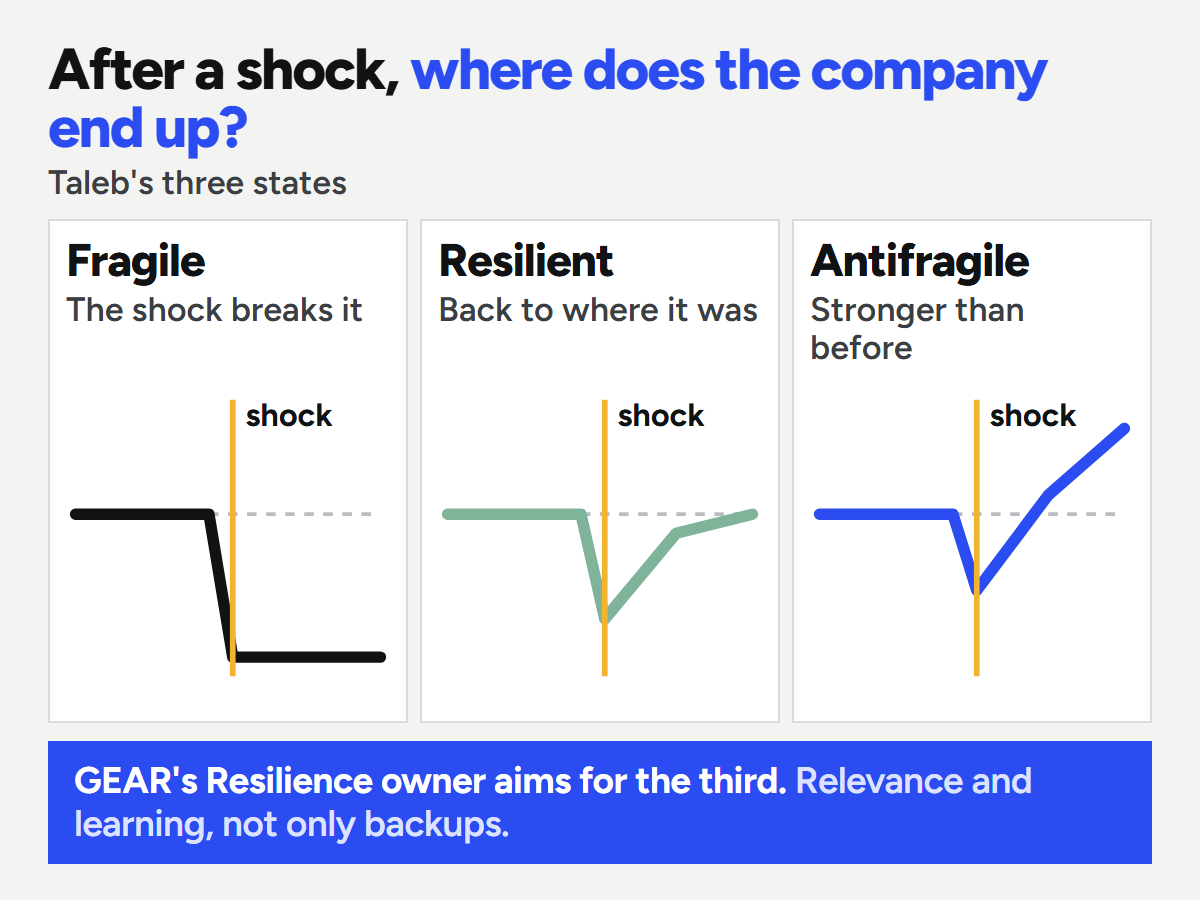
Resilience in one line: the company stays in the picture, and gets stronger from each shock instead of only surviving it. Nassim Taleb calls that antifragile.
Who Holds the Four Jobs as You Grow
At the start the founder holds all four jobs, or two founders split them by strength. As the company grows, hand them off one at a time, starting with the one that hurts most. Around thirty people the founder usually keeps selling, a delivery lead takes Efficiency and Agility together, and a part-time risk lead takes Resilience. Around 120 people, each job has its own owner.
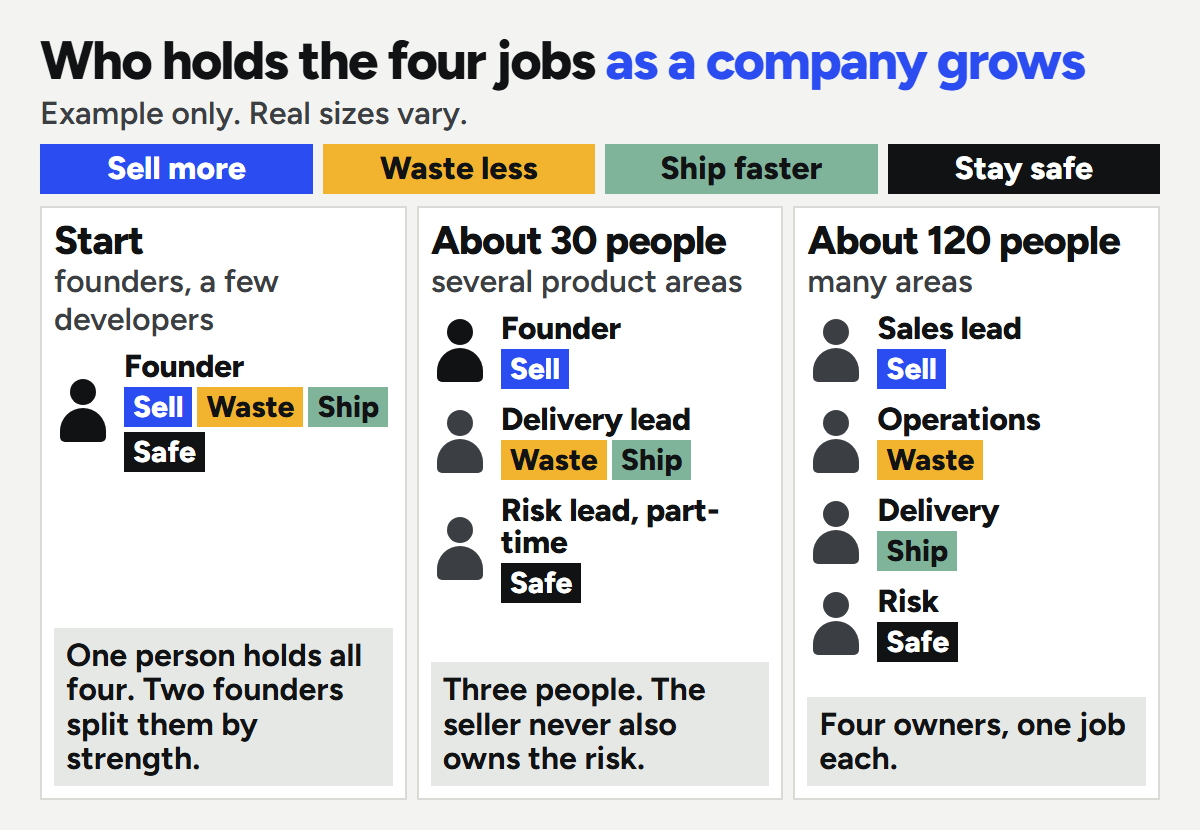
The sizes are examples. Count areas, workload and contracts, not only people.
Six Rules, Tested
These are the rules after testing. Two of them differ from the first draft, which paired selling with risk and waited two quarters before any full-time hire. Both broke in the tests below.
- One owner per job. Two founders split the four jobs by strength from day one. Amazon's "single-threaded leader" is the same idea.
- Hand off by pain, not by calendar. Start with the job that hurts most. In fast growth, two at once is fine if each has a number.
- Never put selling and risk in one chair. The person paid to grow cannot also sign off the risk. In a regulated company an auditor will flag it.
- Pair the other three by what each person controls. Efficiency with Agility works in most companies. Efficiency with Resilience works where quality, supply or compliance dominate.
- Hire full time when the work fills a week. It recurs weekly, has an owner and a number, and has held for 8 to 10 weeks, or one full development cycle in a long-cycle business. Before that, buy it part-time. These thresholds are rules of thumb, not sourced figures.
- Outside rules come first. A regulator or a contract that names an owner overrides every threshold above.
Five Companies, Tested
The five companies below are hypothetical. They were used to try to break the rules, not to prove them, and the tests are thought experiments, not case studies. All five came out the same way: the idea holds, with changes.
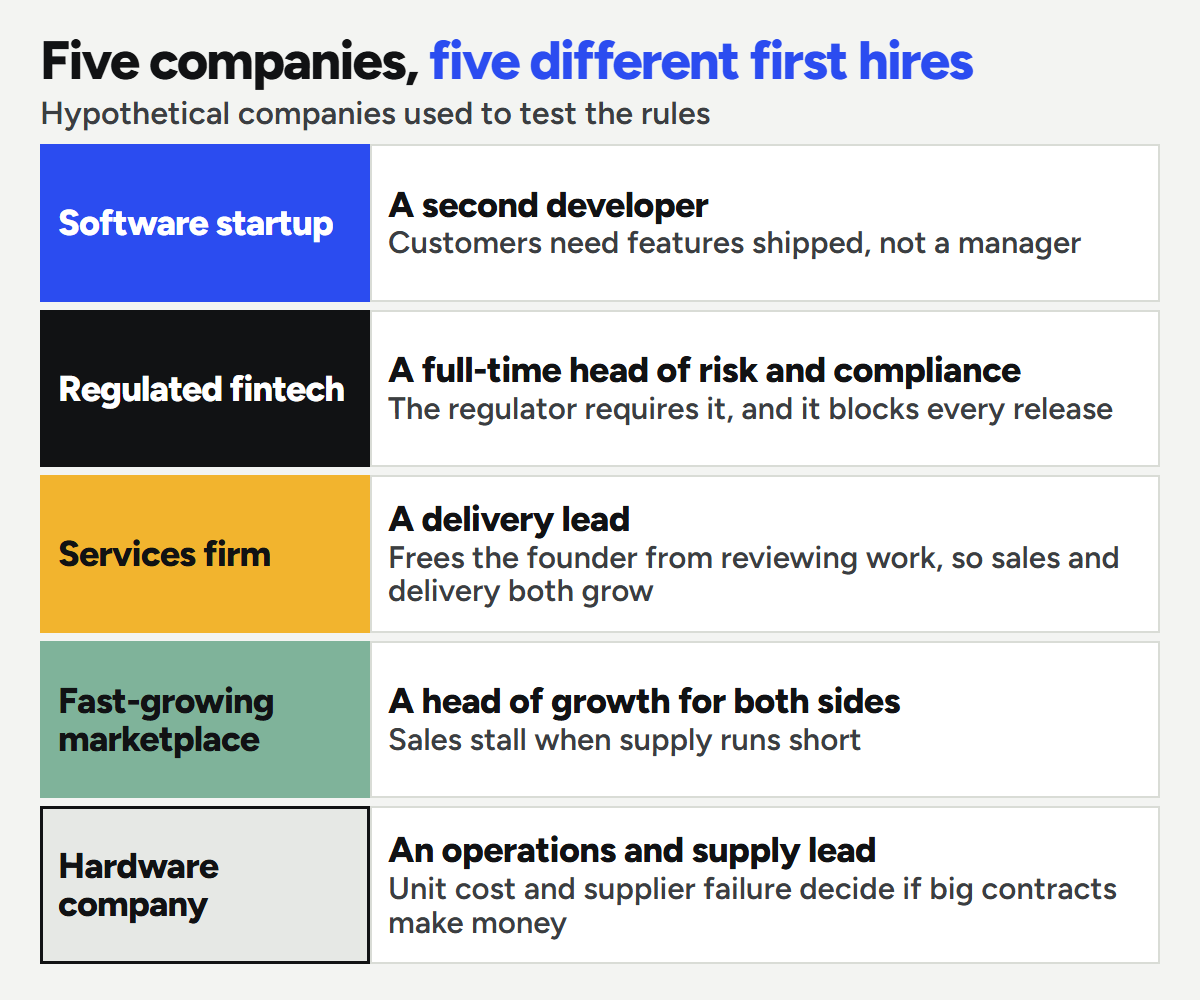
| Company | What broke | What changed |
|---|---|---|
| Software startup (8 to 120 people) | No seat for product ownership. Retention falls between Growth and Resilience. Waiting two quarters is too slow. | Name a product owner by about 15 people. Put retention under Growth with a number. Skip the wait for roles tied to revenue or delivery. |
| Regulated fintech (40 to 150) | The founder cannot hold all four. One person selling and signing off risk is a conflict. "Ship fast" fights the controls. | Risk owner first, never combined with Growth. Count compliance time inside Agility. Regulators override the thresholds. |
| Services firm (25 to 80) | Efficiency and Agility are one job, delivery. People capacity has no owner. The real bottleneck is the founder's review, not sales. | Three jobs: Growth, Delivery, Capacity and risk. Hand off what blocks billable work first. |
| Fast marketplace (60, then cut to 40) | One at a time is too slow. No rule for giving jobs back when shrinking. Resilience stayed with the founder until the bad quarter. | Two handoffs at once if each has a number. A named Resilience owner from day one, even a few hours a week. Merge jobs when you shrink. |
| Hardware company (30 to 100) | "Ship fast" does not fit releases every 12 to 24 months. Customer count is a poor stage signal. Two quarters is shorter than one development cycle. | Agility means decision speed and milestones. Stage by backlog and pipeline. Test over one full cycle. |
How to Write Each Hire
Write a scorecard, not a job description: a mission and a handful of measurable outcomes (Smart and Street's method). Give each seat one strength. If a job needs two opposite strengths, split it between two people.
Mission: the founder stops reviewing routine work. Outcomes: zero founder hours on routine review within two quarters; on-time delivery and rework tracked weekly.
Mission: every release clears compliance on a known timeline. Outcomes: no repeat audit findings; review time per release cut to a target agreed with engineering.
Test with work, not talk. A work sample or a structured interview predicts performance far better than a casual chat. In the 2022 re-estimate by Sackett and colleagues, structured interviews score .42 and work samples .33.
Ask one extra question. End every interview with one line: if not this seat, which of the four jobs would this person do well? Candidates declined for one job go to the owners of the others, so a good candidate rejected for the wrong seat is found by the right one.
Before You Hire Full Time
- For two weeks, have each person log their hours under the four jobs.
- Group the hours by job. The job with the most hours that nobody owns is your next hire.
- If it does not fill a working week, buy it by the day, as an interim or fractional hire, until it does.
Where This Does Not Fit
- Under about ten people with one founder, there is nothing to split.
- A product company needs a named product owner by about 15 people. GEAR has no seat for it.
- A services firm bills people's time, so people capacity needs an owner too. There, treat the four jobs as three: Growth, Delivery (Efficiency and Agility together), and Capacity and risk.
- Resilience holds two jobs: staying relevant (a market job) and managing risk (a control job). If they split in your company, give each its own owner.
- Customer count is a poor stage signal when a company has a few large contracts. Use backlog or pipeline.
- The sizes, pairings and thresholds come from the five thought experiments above. Treat them as starting points to test on your own team.
Sources
- Amazon / AWS, Two-Pizza Teams and the Single-Threaded Leader. aws.amazon.com
- Nassim Nicholas Taleb, Antifragile: Things That Gain from Disorder (Random House, 2012) - systems that gain from volatility and shocks instead of only resisting them.
- Geoff Smart & Randy Street, Who: The A Method for Hiring - the scorecard (mission, measurable outcomes, competencies), not a job description. geoffsmart.com
- Paul R. Sackett, Charlene Zhang, Christopher M. Berry, Filip Lievens, Revisiting meta-analytic estimates of validity in personnel selection, Journal of Applied Psychology, 2022 - structured interview operational validity about .42. pubmed.ncbi.nlm.nih.gov
- HumRRO, summary of Sackett et al. (27 Sep 2022) - work samples .33 and cognitive ability .31, against .42 for structured interviews. humrro.org
Related Reading
- The People Operating System - the people layer underneath GEAR: how the HR function runs as an enabling team across hiring, onboarding, leveling, performance, recognition, and exits.
- The Unicorn Trap - the deep dive on why some roles are unfillable (the psychology of planners vs executors) and how to split, pair, or scope them. GEAR's role section in one essay.
- The KPI Trap - why the wrong metric on the shared scoreboard pulls planners and executors apart, and how to choose KPIs that hold.
- The Expanding PM - how the Product Manager role keeps absorbing work, and why that makes it so hard to staff in one person.
- The 10x Rule - why the structural gaps GEAR catches get roughly 10x more expensive to fix after a growth event than before it.

May Mor
Interim and fractional product, program and operations lead. M.Sc in AI, former Technical PM at a digital bank, where I built the onboarding for a growing R&D team, and an adtech company. Full bio →